The latest episode of BrokerBin Insights, hosted by Renee Kuehl, CEO of BrokerBin, brought together industry experts to discuss one of the most pressing issues in enterprise IT: the right to repair. This episode featured Astrid Wynne from FreeICT Europe and Shannon Mahaffey, founding member and president of FreeICT USA, who is also the COO of Origina. Together, they shed light on the challenges and opportunities surrounding enterprise hardware and software repair rights.
The Right-to-Repair Challenge
The right-to-repair movement has gained significant traction in recent years, particularly in the consumer electronics space. However, as Shannon highlighted, enterprise IT remains largely under the radar. Despite being critical to businesses and organizations worldwide, enterprise hardware and software continue to be restricted by Original Equipment Manufacturers (OEMs) through end-of-support and end-of-life policies. These restrictions stifle innovation, force unnecessary upgrades, and ultimately increase costs for businesses.
At its core, the Right to Repair movement argues that if a business has purchased hardware or software, it should have the right to repair and maintain it. However, OEMs have implemented policies to protect their intellectual property, often at the expense of customer autonomy and sustainability.
The Environmental and Economic Impact of E-Waste
The consequences of these restrictive practices are far-reaching. E-waste is a growing global concern, with enterprise IT contributing significantly to the problem. Electronics manufacturing requires vast amounts of resources, including critical minerals—50 of which have been identified as essential by the US government. Discarding functional enterprise IT hardware not only harms the environment but also results in substantial financial waste.
Shannon pointed out that businesses squander over $1 trillion annually on unnecessary IT upgrades. These forced upgrades drain budgets that could be used for true innovation. According to Gartner, up to 70% of IT budgets are spent on maintaining and upgrading existing systems, with some government agencies spending over 90% of their IT budgets on legacy systems. The financial and environmental costs of maintaining outdated systems without repair options are astronomical.
Sustainability and IT: A Growing Business Concern
Astrid emphasized that sustainability in IT is not just about reducing waste but also about making smarter choices from the outset. Avoiding over-provisioning, eliminating bloated software, and efficiently managing hardware can significantly reduce business environmental impact. Businesses are increasingly recognizing these concerns, as extreme weather events and global resource shortages pose risks to their operations and national security.
With new sustainability regulations, such as the Corporate Sustainability Reporting Directive (CSRD) in the EU, some companies are required to report on sustainability practices. Astrid advised that organizations that prepare for these regulations and integrate circular services into their business models will gain a competitive edge.
The Legislative Battle for Repair Rights
FreeICT USA is actively working to push legislation that supports the right to repair in enterprise IT. Shannon noted that while organizations like Repair.org have made significant progress on the consumer side, enterprise IT faces unique challenges. Although some legislative wins have occurred—such as in New York and Colorado—powerful tech lobbyists continue to push back against reform efforts when it comes to enterprise IT.
To combat these challenges, FreeICT is advocating for the Right to Repair across the state and federal level. Our key legislative goals include:
- Prohibiting anti-competitive licensing practices that force unnecessary software upgrades.
- Enforcing transparency in end-of-support policies.
- Allowing independent support and maintenance for products that are still functional.
- Promoting sustainable design practices that enhance product longevity and repairability.
- Challenging outdated support models that limit choice and increase costs for enterprise IT users.
The Path Forward
Shannon closed out the webinar with a pertinent quote from the FTC’s “Nixing the Fix” report:
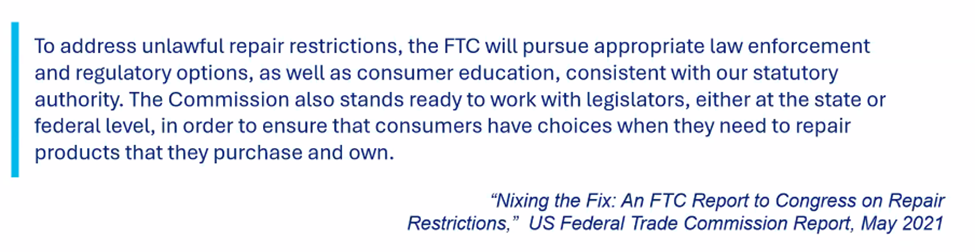
FreeICT USA is working to do just this; to ensuring an environment where both consumers and businesses can be confident that if you bought hardware or software: you own it. If you are interested in learning more, the team at FreeICT USA would be happy to talk to you about what you can do to support the right to repair at the state or federal level.
You can watch the webinar in full on our YouTube channel here: FreeICT USA on the BrokerBin Insights Webinar
